
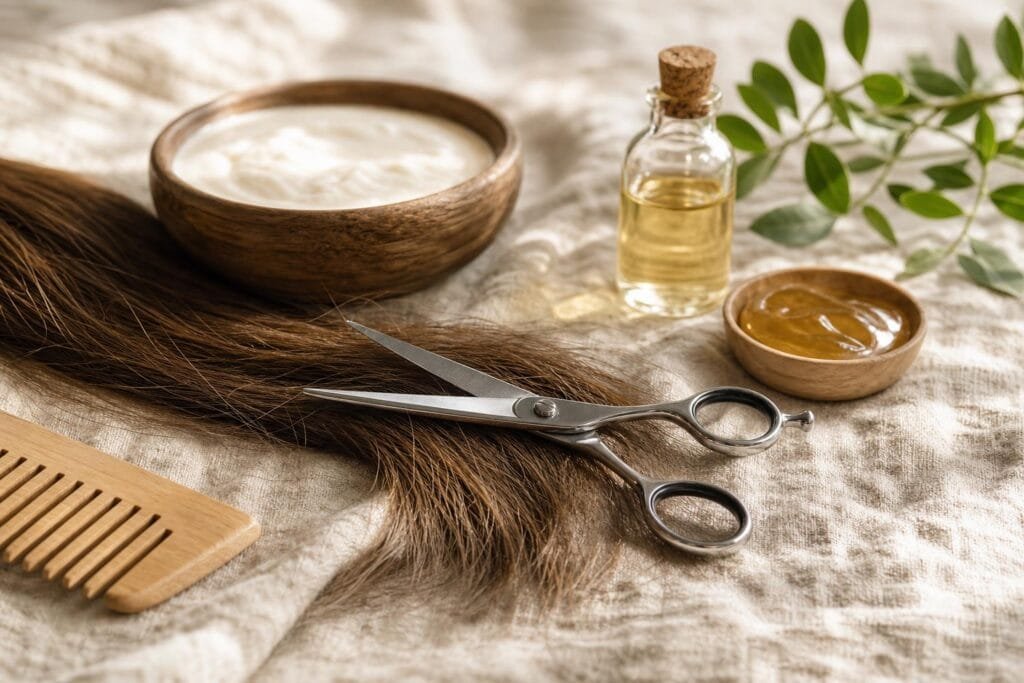
Learn how often to trim your hair to prevent split ends, with guidance for different hair types, practical tips, and product recommendations.
To prevent split ends, trim your hair every 8 to 12 weeks if you want to maintain your current length. If you are growing your hair longer, you can extend to 12 to 16 weeks. Fine or damaged hair may need a trim every 6 to 8 weeks. Regular trims remove existing splits and stop them from traveling up the strand.
Key takeaways
- Trimming every 8 to 12 weeks is standard for most hair types to prevent split ends from worsening.
- Fine or chemically treated hair often needs more frequent trims, about every 6 to 8 weeks.
- Coarse or curly hair can go 10 to 16 weeks between trims because it is more resilient.
- Trimming does not make hair grow faster; it removes damaged ends to keep hair looking healthy.
- Preventive habits like gentle detangling and regular conditioning reduce the need for frequent trims.
What causes split ends and how do trims help?
Split ends, also called trichoptilosis, occur when the protective outer layer of the hair (the cuticle) wears away and the inner fibers fray. This happens from mechanical stress, heat styling, chemical treatments, and environmental exposure. Trimming removes the frayed ends before the split travels up the hair shaft, which can make the hair look thinner and more prone to breakage.
Hair is not a living structure; once the cuticle is damaged, it cannot heal itself. Products can temporarily smooth the appearance of split ends, but they do not repair the damage. The only permanent solution is to cut off the damaged portion. Regular trims therefore are a maintenance step, not a treatment for a medical condition.
How often should you trim your hair based on hair type?
The ideal trimming schedule depends on your hair’s texture, porosity, and how you style it. Fine hair tends to show damage more quickly because it has less structural support. Coarse hair can withstand more wear before splitting. Curly and coily hair often hides splits within the curl pattern, so it may need less frequent trims but more careful handling.
Below is a general guide. Adjust based on how your hair feels and looks.
| Hair type | Suggested trim frequency | Why |
|---|---|---|
| Fine, straight | Every 6–8 weeks | Prone to breakage and shows damage quickly |
| Medium, wavy | Every 8–12 weeks | Balanced resilience; regular trims maintain shape |
| Thick, coarse | Every 10–14 weeks | Stronger cuticle; can go longer between cuts |
| Curly, coily | Every 12–16 weeks | Natural oils coat the strand; trims focus on shape |
| Chemically treated (color, relaxer) | Every 6–8 weeks | Chemical processes weaken the cuticle |
If you heat style daily or live in a dry, dusty climate like parts of Pakistan, you may need to trim more often. Conversely, if you air-dry and protective style, you can stretch the interval.
How to tell if you need a trim before your scheduled appointment
You do not always need to wait for a calendar date. Certain signs indicate that split ends are already present and a trim is due. Run your fingers along a small section of hair from mid-length to ends. If it feels rough or catches, you likely have splits. Hold the ends up to a light; frayed, lighter tips are another indicator.
Other signs include tangles that form more easily at the ends, hair that looks stringy after washing, and a dull appearance that does not improve with conditioning. If you see white dots or small breaks along the shaft, those are split ends that have already traveled. Trimming now prevents further damage.
Step-by-step: how to trim your hair at home (or prepare for a salon visit)
If you choose to trim at home, work with clean, dry hair. Wet hair stretches and can lead to uneven cuts. Use sharp hair-cutting scissors; dull scissors crush the cuticle and create new splits.
- Section your hair into four parts: top, sides, and back. Clip each section out of the way.
- Take a small, thin subsection (about 1 cm wide) and comb it smooth.
- Hold the hair between two fingers and slide your fingers down to the ends.
- Trim only the very ends, about 3–6 mm, using a single snip. Do not saw back and forth.
- Work through all sections, checking for splits as you go. If you find a split that has traveled up, trim above it.
- After trimming, apply a leave-in conditioner or serum to smooth the cuticle.
For a more precise cut or if you are unsure, visit a professional stylist. They can assess your hair’s condition and recommend an appropriate schedule.
Common mistakes that make split ends worse
Many people unintentionally accelerate split end formation through daily habits. Avoiding these mistakes can extend the time between trims.
- Brushing wet hair aggressively. Wet hair is fragile. Use a wide-tooth comb and start from the ends, working upward.
- Using high heat without protection. Always apply a heat protectant before blow-drying or flat-ironing. Keep tools on medium heat.
- Over-washing. Frequent shampooing strips natural oils. Wash every 2–3 days or as needed for your scalp.
- Rough drying with a towel. Rub gently or use a microfiber towel or cotton T-shirt to absorb water.
- Ignoring protective styling. Tight ponytails and buns can cause tension and breakage. Use a silk scrunchie like 1 Silk Scrunchie – Gentle & Perfect for All Hair Types to reduce friction.
- Skipping conditioner. Conditioner smooths the cuticle and reduces friction between strands.
What to look for in products that help prevent split ends
While no product can permanently repair split ends, the right formulas can temporarily seal the cuticle, reduce friction, and improve manageability. Look for ingredients like silicones (dimethicone, cyclopentasiloxane) that coat the hair, natural oils (argan, coconut, jojoba) that add slip, and hydrolyzed proteins that may temporarily fill gaps in the cuticle.

Avoid products with high alcohol content, which can dry out hair. For a simple routine, consider a gentle shampoo, a moisturizing conditioner, and a weekly deep-conditioning mask. Flambeauty offers a Beauty Care Deal that bundles essential hair and skin care items. You can also explore more options in our Hair Care category.

For scalp health, which supports overall hair strength, read our related post on how ginger extract supports scalp circulation and hair health. And if you layer facial oils and serums, see our guide on layering facial oils and serums for maximum glow.
How to make trims last longer
Extending the time between trims is possible with consistent care. The goal is to minimize damage so that ends stay intact longer.
- Wash with lukewarm water; hot water opens the cuticle and causes dryness.
- Apply a leave-in conditioner or hair serum to damp ends after washing.
- Limit heat styling to once or twice a week. Use the lowest effective temperature.
- Wear a silk scarf or use a silk pillowcase at night to reduce friction.
- Deep condition weekly to restore moisture and elasticity.
- Eat a balanced diet with enough protein, iron, and vitamins, as nutritional deficiencies can affect hair strength.
According to the American Academy of Dermatology, gentle handling and regular conditioning are key to maintaining healthy hair and scalp. If you notice excessive shedding, breakage, or scalp irritation, consult a dermatologist, as these may be signs of an underlying condition.
When to see a dermatologist
Split ends are a cosmetic concern, but sudden changes in hair texture, widespread breakage, or hair loss can indicate a medical issue. If your hair breaks easily despite good care, or if you have patches of thinning, see a dermatologist. They can evaluate for conditions like thyroid disorders, nutritional deficiencies, or scalp infections. Do not attempt to treat these at home.
For more hair and skincare advice, visit the Flambeauty blog. Regular trims, gentle handling, and the right products will keep your hair looking its best.
Frequently Asked Questions
Does trimming your hair make it grow faster?
No, trimming does not affect the rate of hair growth from the follicle. Hair grows about 1 to 1.5 cm per month regardless of trims. Trimming only removes split ends and prevents them from traveling up the strand, which can make hair look healthier and longer over time.
Can you prevent split ends without trimming?
You cannot permanently repair split ends once they form, but you can slow their development with gentle handling, regular conditioning, and minimizing heat and chemical damage. However, the only way to remove existing split ends is to cut them off.
How often should you trim curly hair to prevent split ends?
Curly and coily hair can typically go 12 to 16 weeks between trims because the natural oils coat the strand and the curl pattern hides splits. However, if you heat style or color treat your curls, you may need to trim every 8 to 10 weeks.
What happens if you never trim your hair?
If you never trim, split ends can travel up the hair shaft, causing breakage and thinning. Over time, the hair may appear frizzy, dull, and uneven, and it may not grow past a certain length because the ends break off.
Are there products that can seal split ends temporarily?
Yes, some leave-in conditioners, serums, and oils can temporarily smooth the appearance of split ends by coating the cuticle. Look for ingredients like dimethicone, argan oil, or hydrolyzed proteins. These products do not repair the damage but can improve manageability until your next trim.
Written by Mishal Rehman, owner of Flambeauty — sharing practical, professional beauty and skincare guidance.
Updated: October 2026